How to Tell if a Delivery Text Is Real
To check a delivery text, open the retailer’s order history or carrier’s established app independently. Verify the shipment and requested action. Leave the text’s link and phone number alone. An expected parcel, familiar sender or small fee does not authenticate the message.
Some carriers send genuine texts, including customs notifications. A tiny fee can introduce a very untidy bill. Check the particular request.
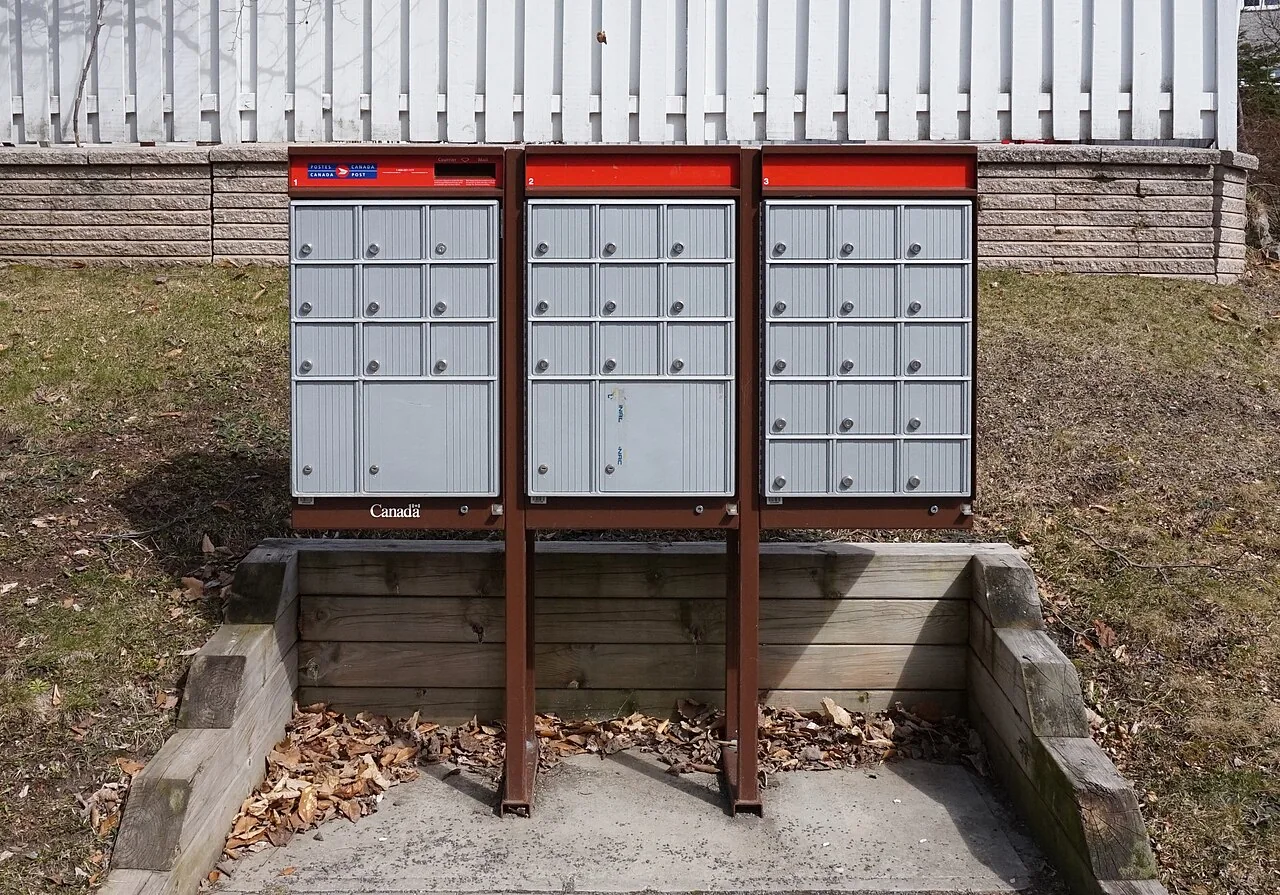
Canada Post community mailboxes in Lévis, Quebec. Postal context image; not a photograph of a reported fraud. Photographed on 30 April 2015.
Bernard Gagnon — Community mailboxes - Canada Post.jpg / CC BY-SA 3.0. Source-served resized photo; no editorial crop or colour changes. Proportionally resized and WebP-compressed; no crop or colour changes.

An expected parcel can make an unexpected request convincing
Delivery scams exploit a familiar situation: you are waiting for something. The message supplies a problem and an urgent fix. In its 15 October 2024 report, Sunshine Coast RCMP described fake Canada Post texts claiming border-security holds and demanding unpaid shipping fees. It documented no individual loss or recovery.
Delivery fraud is one form of SMS phishing, or smishing. On 23 April 2026, Toronto Police reported arrests and equipment seizures in a broader SMS investigation. This was not a parcel-only case or a conviction.
An older German case shows the possible consequence. Mainz police reported on 28 July 2025 that a failed-delivery text led to banking details being entered and about EUR 2,000 in unauthorised debits. No recovery was reported.
Four steps to check the delivery without using the text
Hypothetical worked example: you are waiting for headphones. A text says your address is incomplete and asks for CAD $1.25 to prevent a return. The amount and scenario below are illustrative, not a reported customer incident.
1. Find the shipment in your order history
Open the retailer’s app or your usual bookmark. Read the order’s carrier and tracking number. In this example, the headphones order lists Canada Post and a shipment in transit. Your reference comes from outside the suspicious message.
2. Reach the carrier independently
Open its established app or type its known website address into the address bar. Avoid search ads, the text’s link and its support number. Here, you open the Canada Post app and enter the retailer’s tracking number. The text has not chosen your destination.
3. Check the requested action as well as the parcel
Check the independent tracking record for an address issue or charge. A matching tracking number alone does not authenticate a payment request. Here, tracking shows no problem or payment due. You withhold the CAD $1.25 and your card details; contact independently found support if the records are unclear.
4. Complete any genuine task through the verified route
Resolve a confirmed problem through that independent route. Check the amount, recipient and purpose before approving anything. In the example, you make no payment and leave the genuine shipment unchanged. You have avoided this unverified request.
Do legitimate carriers send delivery texts?
Yes, but their rules differ. Canada Post’s fraud guidance recognises opted-in tracking texts while rejecting texts requesting card information, login details or delivery/tracking payments. Separately, it supports duties-and-taxes notifications and payment through independently opened tracking. A genuine customs bill and an unsolicited “release your parcel” demand need different treatment.
Keep each rule attached to its service. USPS tracking texts contain no links; FedEx documents some genuine import-duty SMS. Neither rule applies universally. Check the actual shipment independently.
Reassuring details that still need checking
| What you recognise | What it cannot establish |
|---|---|
| A parcel you actually ordered | That this message concerns that order. |
| A familiar sender or existing thread | That the carrier sent this particular text. |
| Your name or a tracking number | That the payment or information request is authorised. |
| A polished page with HTTPS | That you reached the intended organisation. |
| A tiny charge | That the possible loss is limited to that amount. |
The Canadian Cyber Centre’s April 2026 guidance explains how spoofed senders can place fraudulent texts inside legitimate conversations. An old thread can therefore contain a new code request. Check what that code would authorise.
If you already clicked or entered information
Respond to the exposure, rather than assuming either complete safety or complete compromise. Merely receiving a text differs from opening its page, entering card details or installing software. If you opened a page, close it, stop interacting and review what you entered, downloaded or allowed. Information may have been captured before you pressed Submit.
- Card details, money or an approval supplied: contact your bank or card issuer promptly through its established app or the number on your card. Describe any payment, code or digital-wallet setup involved.
- Password supplied: change it through the genuine service, address reused passwords and review account access.
- App installed or permissions granted: seek device-specific help through the device provider or workplace IT, using another trusted device if necessary.
- A follow-up “bank” call arrives: end it and contact the bank independently. Do not approve another action to supposedly cancel the first.
Save the message and relevant transaction records without reopening the suspect link. In Canada, use your messaging app’s spam report or forward the text to 7726; report fraud to police and the Canadian Anti-Fraud Centre through the government’s reporting guidance. In the US, use USPIS for USPS impersonation or ReportFraud.ftc.gov. Reporting does not guarantee reimbursement.
Keep the independent check available
Your existing retailer and carrier accounts provide a practical verification route. Gemisis’s trust model describes a separate check against registered sender-side evidence where a supported integration covers the communication. A confirmed origin does not authorise a payment; a missing match remains unconfirmed. This article does not claim carrier participation or universal parcel-text verification.
See how bank phone numbers can be spoofed for related context.
Frequently asked questions
How do I know if a delivery text is real?
Find the order independently, then confirm the shipment and requested action with the carrier. Appearance alone is insufficient.
Is a delivery text with a link always fake?
Rules differ: USPS tracking texts have no links. Avoid an unverified link and check the carrier independently.
Can a scam appear in the same thread as real delivery texts?
Yes. Spoofing can place fraudulent texts in an existing conversation. The thread does not authenticate a new request.
Does a small redelivery fee mean the risk is small?
No. It can lead to card disclosure or another authorisation. Check independently before providing either.
What if the tracking number is real?
Use the number from your order history and check the action separately. A real shipment does not authenticate the text.
What should I do after entering my card details?
Contact the issuer promptly through a trusted route. Describe the information and approvals, and preserve records. Do not wait for a debit.